
Course
Hifz Completion Course
Most people who stop memorising stop because the remaining distance feels vague and endless. This course begins by mapping exactly what is left, then sets a dated plan you can actually finish.
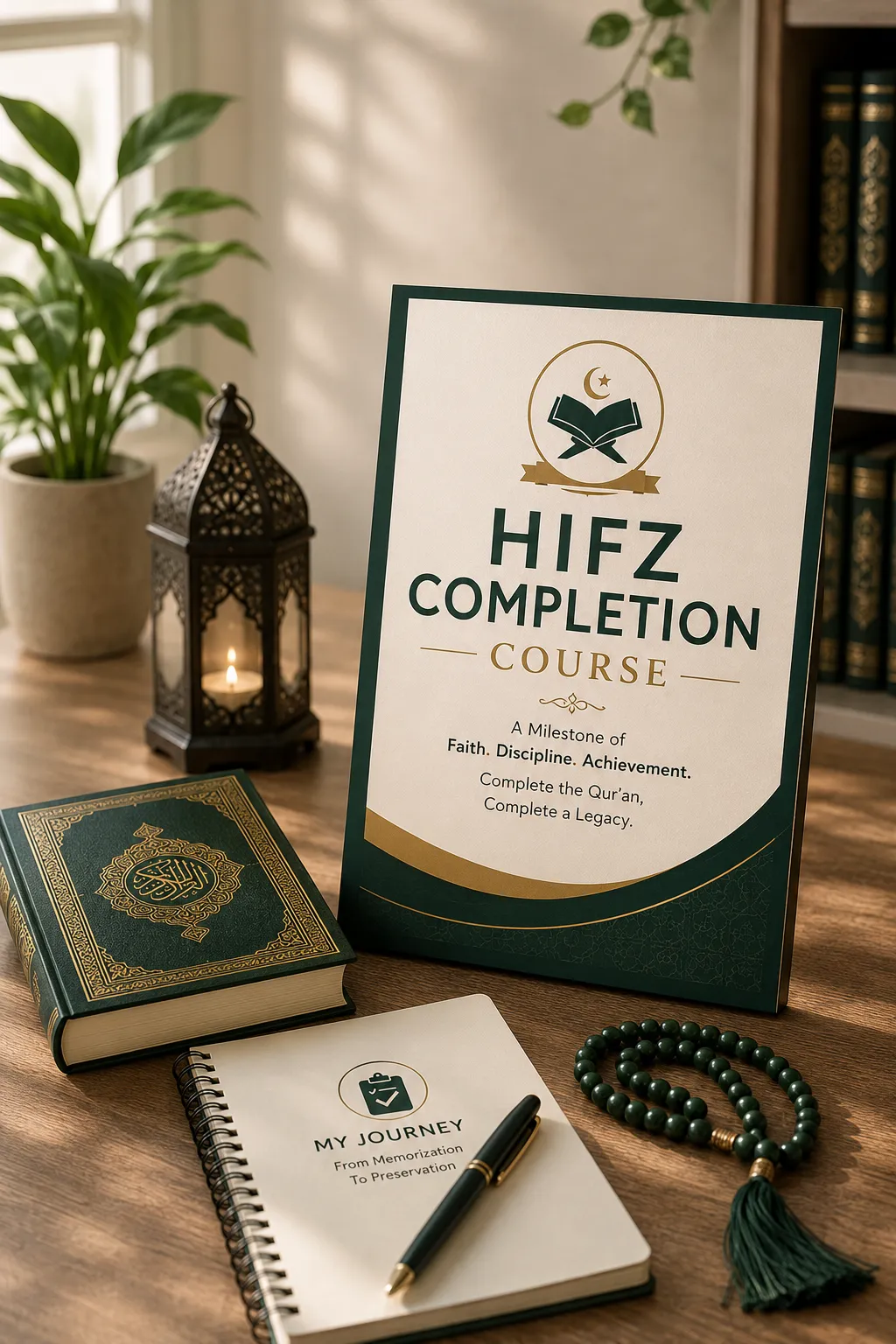
Overview
From 'someday' to a date on the calendar
There is a particular kind of stuck that affects paused Hifz students. You know you have some juz. You are not sure how many are still solid. You do not know how long finishing would take, so you cannot plan for it, so you do not start. Years pass in that state, and the portions you did memorise keep quietly weakening in the meantime.
This course breaks that loop by starting with information. In the first week your teacher tests everything you have and produces three numbers: how much is solid, how much needs repair, and how much was never memorised at all. From those, you get a realistic completion date — not a motivational one, an arithmetic one.
Then comes repair, before anything new. Adding fresh memorisation on top of weak foundations is why many students stall a second time. The weakened portions are rebuilt first, which is faster than it sounds, because relearning something you once knew is far quicker than learning it cold.
Only then does the completion phase begin: the remaining juz, on a dated schedule with weekly targets. Before you finish, there is a full end-to-end revision pass, so that on the day you complete the Quran you actually hold all of it, not just the parts you memorised most recently.
Who it's for
Is this the right course for you?
-
1
Students who paused
Anyone who stopped memorising — a year ago or fifteen — and wants to finish. The gap is expected and planned for.
-
2
Students close to the end
If you have twenty or more juz and need a structured push to complete, this course provides the schedule and accountability.
-
3
Adults returning to Hifz
Adults who memorised as children, moved on to work and family, and want to finish what they began.
Outcomes
What you will achieve
Every student is assessed in the first class and placed at the right starting point, so nobody repeats what they already know.
- Know exactly how much is left and by which date
- Rebuild the portions that weakened while you were away
- Memorise the remaining juz on a weekly schedule
- Complete a full-Quran revision before finishing
- Recite the entire Quran from memory
- Leave with a maintenance plan so it stays
Curriculum
How the course is structured
Map, repair, complete, revise. Each phase has to finish before the next begins.
-
1
Mapping week
Testing every juz to establish what is solid, what is weak, and what was never memorised. This produces your completion date.
-
2
Repair phase
Rebuilding weakened portions before adding anything new, so the foundation can carry the rest.
-
3
Completion schedule
A dated week-by-week plan for the remaining juz, with targets you can actually hit.
-
4
Daily routine
Sabaq, sabqi and manzil running together, so new memorisation never comes at the cost of what you already hold.
-
5
Final full revision
A complete pass from Al-Fatihah to An-Nas before completion is declared.
-
6
Maintenance handover
A long-term revision cycle set up before you finish, so there is no gap after the celebration.
Inside a lesson
What a class
looks like
An intensive hour, because completion needs both new memorisation and heavy revision in the same session.
-
1
Manzil
Scheduled long-term revision from the rotation.
-
2
Sabqi
Recent portions recited and corrected.
-
3
New sabaq
The next portion in the completion schedule.
-
4
Targets
Progress against the plan and the target for tomorrow.
Before you start
What you need
-
Existing memorisation, however weak it currently feels
-
Availability for five classes a week — this course depends on intensity
-
Willingness to do repair work before new memorisation
-
Practice time outside class, typically 45 minutes daily
Students
From students on this course
-
❝
I stopped at fourteen juz in 2011. Having an actual finishing date on paper changed everything about how I approached it.
Ahmed T. United Kingdom
-
❝
The repair phase felt like going backwards for six weeks. Then the last eight juz went faster than anything before it.
Sana K. Canada
FAQ
Questions about
this course
Still unsure? Message us on WhatsApp and a coordinator will answer the same day.
Ask a coordinator →I stopped years ago — is that a problem?
No, and it is the most common situation for students on this course. The repair phase is built in precisely because of it.
How fast can I finish?
It depends on how much remains and how much repair is needed. You get a realistic date in the first week rather than a guess on day one.
What if I fall behind the schedule?
The plan is adjusted rather than abandoned. Falling behind is normal and expected; abandoning the plan because of it is what actually stops people.
Do I have to do five days a week?
We strongly recommend it. Completion depends on momentum, and at two or three days a week the finishing date moves further away than most students find bearable.
What happens after I complete?
You move onto a maintenance cycle, which is set up before you finish so there is no gap. The Memorization Revision Program is designed for exactly this.
Is there a certificate?
Yes, on completion of the full Quran including the final revision pass. We also guide students who want to pursue Ijazah afterwards.
Can adults with full-time jobs do this?
Yes, though the timeline is longer. Early morning slots before work are the most reliable option, and we schedule in every time zone.
Explore
Related courses
Try this course with
three free classes
Meet your teacher, see the method, then decide. No card details needed.